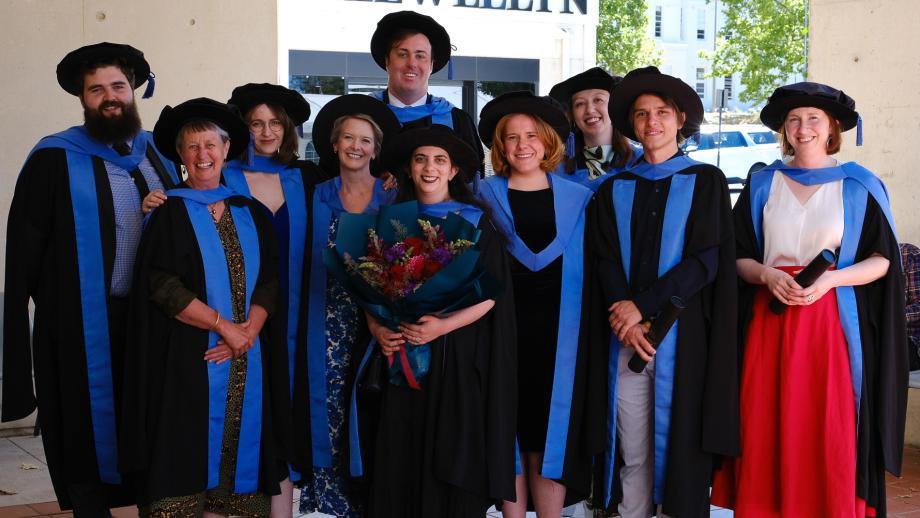
Left to right: Benjamin Hemings, Fiona Navilly, Inga Koralewska, Kym Dosseter, Nicholas Corbett, Susannah French, Isabel Mudford, Jessie Liu, Sean Ward, Rachel Aalders. Photo courtesy Ezreena Yahya
We’re very pleased to celebrate this year’s graduating HDR cohort in the ANU School of Sociology. Their achievements are a sign of our discipline's value and strength in an uncertain world marked by huge change and deeply entrenched structural inequalities.
Sociology is the science of society. It’s a broad, plural field of inquiry that takes our work in many directions. We ask big questions about how society works – then, now and into the future – and who it works for, and then we stay with those questions long enough to understand what’s really going on and what can be done to make things better and fairer.
This graduating group shows exactly why sociological research is so valuable. Their projects take on a wide range of social issues, but what they share is a commitment to understanding social life with a multi-dimensional view that draws links between things that are often kept separate or invisible in public discussion.
Rachel Aalders looked at how fintech platforms reshape consumer credit through data and moral promise. Cameron Boyle used multispecies ethnography and brought that approach into conversations about environmental loss and extinction, but also species reintroduction, in landscapes in Aotearoa New Zealand and Australia.
Nicholas Corbett examined how algorithmic platforms shape contemporary forms of alt-right ideology and organisation. Kym Dossetor centred women’s experiences of prison governance and their perceptions of prison codes, challenging the male focus that has long dominated prison research. Susannah French explored female experiences of autism, showing how diagnostic systems and institutions often render autistic women invisible.
Ben Hemmings focused on online mental health forums as quasi-clinical spaces, raising important questions about expertise in digital settings, but also exploring the role of participation and gatekeeping in online communities. Inga Koralewska studied abortion practices in Poland to understand how political agency and resistance operate.
Jessie Liu, who was awarded the JG Crawford Prize, researched the infant formula daigou trade between China and Australia, offering a grounded account of transnational exchange as a form of labour that goes well beyond trade narratives.
Isabel Mudford traced how LGBT health emerged as a policy and knowledge category through the AIDS crisis and how this history shapes its contemporary form. Fiona Navilly asked what we really mean when we talk about ‘quality of life’, and how that idea is mobilised in social and institutional settings. Sean Ward examined how outrage circulates on digital platforms and how dissent is shaped by the infrastructures through which it takes place.
We’re so proud of what this group has produced, and of the seriousness and generosity they bring to the discipline of sociology. Their work and collegiality make our area of study stronger, and it will continue to matter well beyond this moment. Our recent graduates are now working in a range of high-powered research, policy, advocacy, education and private sector roles and taking their expert knowledge of social relations into these professions to improve how complex social processes are understood and done.
Congratulations to all of our graduates!